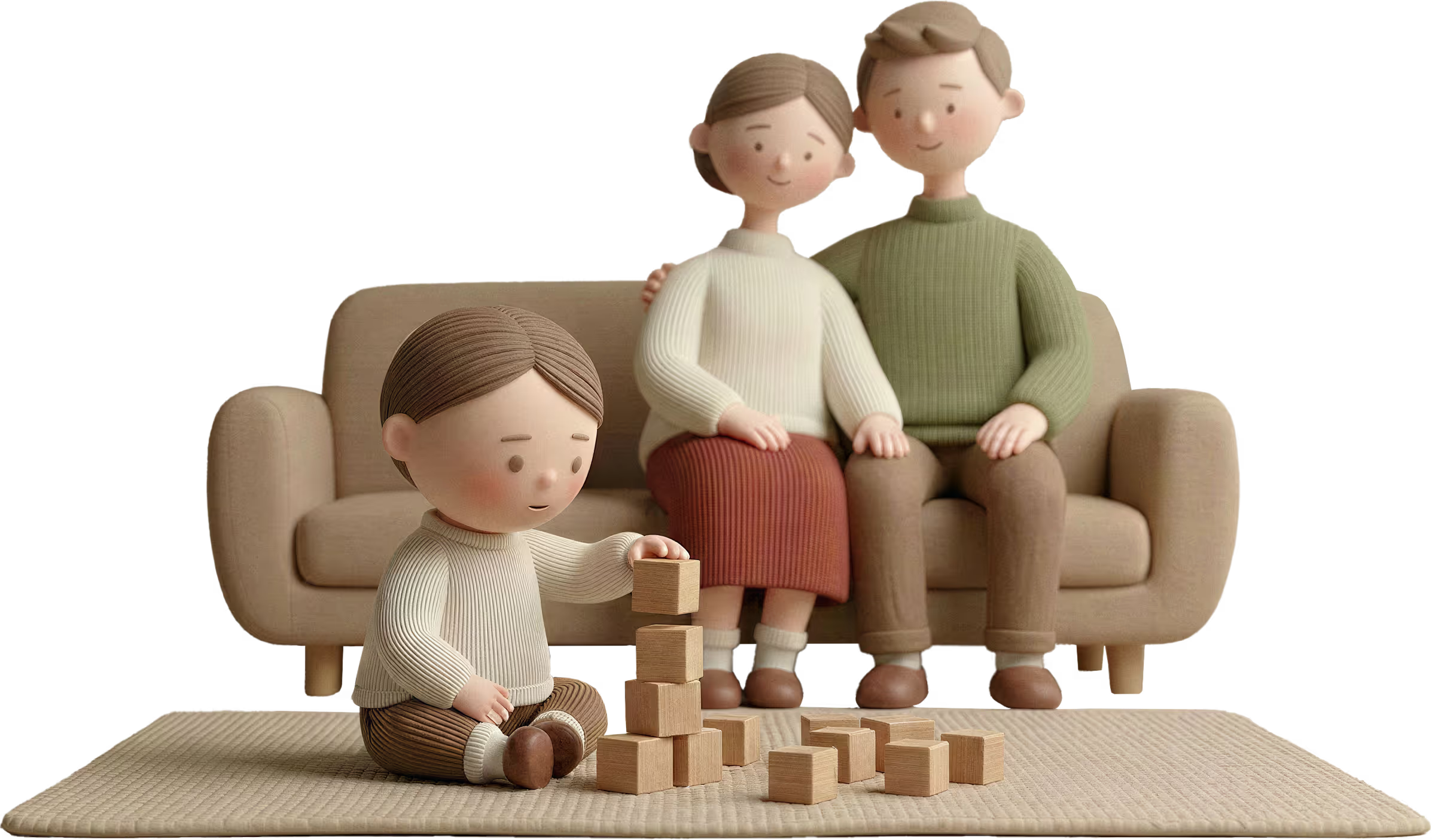
Do this:Find ten to fifteen minutes of one-on-one time every day -- or as close to every day as the newborn allows -- where your older child has your full, undivided attention. Not structured activity. Not teaching. Just following their lead, doing what they want to do, being present without the baby being the subject. This time does not have to be long to be significant. Its significance is in the consistency, not the duration.
Skip this:Focusing primarily on the regression as behaviour to correct while the underlying need goes unmet. Comparing the older child's behaviour to before the baby, which names the regression without addressing the cause. Expecting the older child to understand the baby's needs in a way that asks more emotional maturity than they currently have.
Expect this:That the regression will not resolve in a straight line. A good week followed by a hard one is the pattern, not an exception. The underlying transition -- from only child to older sibling -- takes most children six months to a year to genuinely integrate. The short-term trajectory is less important than the overall direction.
Before the baby, things were working. Your older child was sleeping, or mostly sleeping. Potty trained, or nearly. Managing transitions reasonably well. Then the baby arrived and something shifted -- not in one way but in every way simultaneously. There is regression where there was progress. There is clinginess where there was independence. There is hitting, or crying, or a kind of relentless neediness that is exhausting to be on the receiving end of when you are also feeding a newborn at 3am.
What you are looking at is grief.
Your older child has lost something real and large. They have lost exclusive access to you. They have lost the world as it was -- the rhythms, the routines, the version of the family where they were the only one. They did not choose this. They were not consulted. One day the world was one shape and now it is a different shape, and the person they most need to help them process that loss is the same person who is now fundamentally less available to them.
The regression is not manipulation and it is not a step backwards in any permanent sense. It is the behaviour of a child whose cup is very full and whose ordinary resources for managing that fullness -- time with the parent, the comfort of predictability, the feeling of being the centre of someone's world -- have all been reduced at the same time. Toileting accidents, sleep disruption, baby talk, clinginess, hitting -- these are not separate problems. They are the same problem expressing itself across multiple domains.
There is also something worth naming for the parent reading this: the guilt is real. Most parents of a second child carry a version of it. You changed your older child's world without their consent, and now you are watching them struggle with it. That is a painful thing to sit with. It does not mean you made the wrong decision. It means the transition is genuinely hard, for them and for you.
Probably normal if...The regression appeared in the weeks around the baby's arrival and is gradually -- however unevenly -- reducing over the first few months. Your older child shows moments of genuine affection or curiosity toward the baby alongside the difficulty. The regression is across domains but not severe in any single one. Your older child can still be reached and connected with when you have the capacity.
Worth watching if...The regression is intensifying rather than stabilising after the first two to three months. Your older child seems genuinely depressed -- withdrawn, flat, lacking the energy and engagement that characterised them before. The hostility toward the baby is physical and difficult to keep safe. Your own capacity to stay connected with your older child while caring for a newborn has been seriously depleted.
Get outside help if...You are concerned about the safety of the baby around the older child, or the older child's regression is severe enough to significantly affect their functioning at preschool or in daily life. This is also a moment to ask for help for yourself -- the transition to two children is one of the more destabilising events in family life, and support for the parent directly serves both children.
The most common loop after a new baby is an attention economy that has been restructured without anyone acknowledging it.
Before the baby, the older child received a relatively large share of parental attention. After the baby, that share is significantly smaller -- not because the parent loves them less, but because the distribution has changed. The older child is doing what any organism does when a resource becomes scarce: they work harder to obtain it. The regression, the clinginess, the acting out -- these are bids for attention, and they are effective ones, because they produce a parent who stops and responds.
A parent who responds to the regression primarily with correction -- "you know how to use the potty, why are you doing this" -- is providing attention that is negative in content but still functionally rewarding. The child is being seen. Being seen is what they needed. The regression continues.
A parent who proactively provides connection -- before the bid, not as a response to it -- changes the equation. The older child who has already had their ten minutes of full-attention time is a child whose cup is slightly less empty. The regression doesn't disappear, but its urgency reduces.
The second thing that keeps it going is the inadvertent message that the baby is the reason things are hard. A parent who says "I can't right now, I'm feeding the baby" hundreds of times over the first year is accurately describing the situation. The older child is also learning, accurately, that the baby is the variable that changed everything. That association is worth managing -- not by pretending it isn't true, but by also creating moments where the baby's presence is neutral or even positive from the older child's perspective.
Before the day starts, the app can give you a short script for talking to your older child about how things have changed -- something that names the loss without making it bigger. In the hard moments, it gives you language for staying connected while you're stretched thin. And at bedtime, a story made for your older child about being a big sibling can help them find their place in the new shape of things.